
Carriers Have a Preference. Here Is What Makes Your Freight Attractive, or Not.
Every load that moves has two parties with a stake in it: the shipper who needs it covered, and the carrier who decides whether to take it. That decision is rarely neutral. Carriers are running a business, and some freight is simply more profitable and less operationally painful to haul than other freight. When capacity is available, carriers accommodate a wide range of shippers. When capacity tightens, they allocate trucks to the freight they want most.
Understanding what makes freight attractive to the carrier community, and what makes it a load a carrier will pass on when they have options, is one of the more actionable supply chain conversations a VP of Supply Chain or operations leader can have. It does not require a new contract or a technology investment. It requires an honest look at a handful of operational characteristics that carriers are evaluating every time your freight hits the market.
Why Carrier Prioritization Exists and Why It Matters Right Now
Carriers run on margin. Driver pay, fuel, equipment maintenance, insurance, and deadhead miles are the cost structure, and every load either contributes to covering that structure or works against it. A load that is easy to plan around, fast to load and unload, and consistent from week to week is worth more to a carrier than the rate alone suggests. A load that is unpredictable, slow to turn, or difficult on the driver adds hidden cost that carriers have learned to price in… or avoid.
In a balanced or soft freight market, carriers work through the full load board. In a tight market, carriers move toward the freight they prefer and away from the freight that costs them more than it pays. The current truckload environment qualifies: spot rates are running 20% to 25% above year-ago levels. Shippers whose freight has earned a strong profile in the carrier community get covered first. Shippers whose freight has not are the ones calling brokers for spot coverage at a premium, under time pressure, when their primary carrier says no.
The characteristics that drive that prioritization are not secret. They are consistent across the carrier community, and most of them are within a shipper’s direct control.
The Operational Characteristics Carriers Use to Evaluate Your Freight
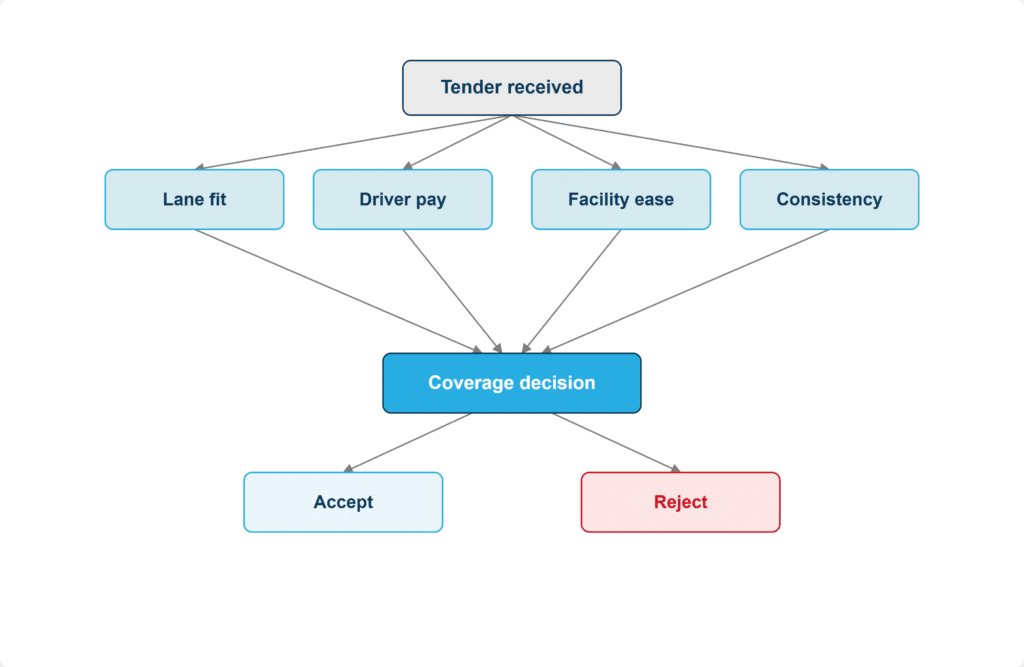
Carriers assess freight attractiveness across a few dimensions. None of them require a formal audit to understand. Most shippers who think carefully about their own operations already know where they stand.
Facility efficiency and dwell time. The time a driver spends at a shipper’s facility, from arrival to departure, is called dwell time, and carriers track it by location. Every hour beyond what a carrier expects is unpaid time for the driver and a scheduling problem for the fleet. A driver detained for three hours at a dock loses productive miles for that day. The carrier absorbs that cost, and they remember it. Facilities with consistently high dwell times develop a reputation in the carrier community that affects acceptance rates over time, independent of what the shipper is willing to pay per mile.
Freight predictability and lane consistency. Carriers build their networks around freight they can plan on. A shipper who tenders consistent volume on consistent lanes gives the carrier something to build a schedule around. That predictability lowers the carrier’s risk of repositioning empty equipment and makes their revenue more forecastable. A shipper whose volumes swing significantly week to week, or whose tender patterns are difficult to anticipate, creates planning uncertainty that carriers factor into their decisions. Variable shippers are not automatically unattractive, but they require more carrier relationship management to maintain strong coverage, and they absorb a higher share of rejections when capacity gets tight.
Driver experience at your facility. Drivers talk, and carriers listen. The experience a driver has at a shipper’s facility, whether they are acknowledged when they arrive, whether the process is organized, whether dock staff treat them professionally, whether there is somewhere to wait comfortably, feeds back to the carrier in ways that are informal but real. Carriers who hear consistently negative feedback about a facility will route their drivers around it when they have alternatives. Facilities with a reputation for treating drivers well become preferred stops, which translates directly into carrier willingness to accept freight.
Load characteristics and accessorial clarity. Freight that is straightforward to handle and priced transparently is more attractive than freight with complications or hidden costs. Loads with special handling requirements, unusual dimensions, or accessorial charges that appear after the fact cost carriers time and create billing disputes. Clear, accurate load information: weight, dimensions, commodity, loading requirements, appointment times, reduces friction at every point of the shipment. Shippers who are known in the carrier community for providing accurate tender information and clean invoicing are easier to do business with, and that reputation matters.
Tender acceptance and rejection patterns. When a carrier accepts a tender, they build that load into their dispatch schedule. When a shipper pulls a tender after it has been accepted, or regularly over-tenders with the expectation that a high percentage will be rejected, it disrupts the carrier’s planning. Carriers track tender compliance by shipper. High tender acceptance rates and low last-minute cancellations signal that a shipper runs a disciplined operation, which makes their freight more plannable and more attractive to cover consistently.
What This Looks Like When Freight Market Conditions Shift
The characteristics above are always in play, but they become visibly consequential when the market tightens. In a soft market, a carrier with excess capacity may absorb a difficult facility or an unpredictable tender pattern because the alternative is an empty truck. In a tight market, that same carrier has options, and they use them.
For food and beverage shippers, this dynamic is particularly acute. Reefer freight has a smaller carrier base to begin with, and the carriers who run temperature-controlled equipment have even more latitude to be selective. A food manufacturing operation that has let dwell times creep up, or that has a reputation for difficult loading conditions, will feel the effects faster than a dry freight shipper when reefer capacity tightens. A missed delivery window in that context is not just a logistics problem, it is a retailer compliance issue with chargeback exposure attached.
Consider two food manufacturers shipping similar freight into the Southeast. One consistently loads drivers within 45 minutes and tenders predictable weekly volume. The other averages three-hour dwell times and frequently changes appointments. During a tight reefer market, the first shipper continues receiving routine coverage while the second experiences tender rejections, spot market premiums, and retailer chargebacks. The difference is not simply price; it is the operational reputation each shipper has built with carriers.
For manufacturing operations, the risk concentrates in JIT inputs and outbound finished goods. A carrier rejection at the wrong moment creates a production scheduling problem that does not stay in the transportation budget. The cost migrates into operations before it shows up in any service metric.
Why This Matters Beyond the Dock
Freight attractiveness is not a transportation metric. It is a leading indicator of cost, service, and risk that shows up in places the freight team rarely gets credit for. A carrier rejection on a reefer lane during a tight market is a missed delivery window. A missed delivery window on a retailer PO is a chargeback. A chargeback pattern is a margin problem that lands on the P&L, not the freight invoice. On the manufacturing side, the same rejection shows up as a stalled line or a missed customer ship date, and the cost of that disruption is rarely measured against the freight spend that could have prevented it. Shipper attractiveness, in other words, is an upstream cause of OTIF performance, retailer compliance exposure, and supply chain resilience, three things executives already track, even when nobody connects them back to dwell time and tender discipline.
Three Questions to Ask Yourself
- Would your top five carriers describe your facilities as easy places to load?
- If capacity tightened tomorrow, would your incumbent carriers prioritize your freight?
- When was the last time you asked carriers for candid feedback on your operation?
If you cannot answer these with confidence, that is itself the finding. Most shippers cannot, because the data that would answer them does not live in a TMS or a rate report.
How to Know Where Your Freight Actually Stands
Most shippers cannot answer this question from their internal data. A TMS shows what got accepted and rejected. A rate report shows what you paid. Neither tells you how your facility’s dwell time compares to what that carrier sees at other shippers on that lane, or how your freight profile is perceived relative to other volume the carrier could run instead.
That gap is where a logistics partner with genuine carrier market presence is useful. A partner who is in the carrier market daily, who knows which carriers are tightening on which lanes, and why, can give you a frank read on where your freight profile is creating risk before a round of rejections makes it obvious. The conversation is more valuable before the market tightens than after.
If you want an honest assessment of where your freight stands with the carriers covering your lanes, reach out. We will walk through your freight profile, your facility reputation, and the lane-level dynamics that are most likely to affect your coverage when conditions shift.
Frequently Asked Questions
What makes freight attractive to carriers?
Carriers prefer freight that is predictable, fast to handle, and operationally straightforward. Consistent volume on consistent lanes, short dwell times at the facility, a positive driver experience, and accurate load information are the primary characteristics that build a strong freight profile in the carrier community.
How does dwell time affect carrier relationships?
Dwell time is unpaid time for the driver and a scheduling cost for the carrier. Carriers track dwell by facility and factor it into acceptance decisions over time. A shipper with chronically high dwell times will see it reflected in carrier behavior — particularly when that carrier has alternative freight to run.
Can shippers with variable freight volumes still build strong carrier relationships?
Yes, but it takes more deliberate management. Variable shippers can offset some of the planning uncertainty by minimizing dwell time, improving driver experience, and working with a logistics partner who can position their freight to carriers where the lane fit is strongest. The goal is to make the freight attractive on the dimensions the shipper can control.
What role does a 3PL play in managing freight attractiveness?
A 3PL with established carrier relationships and daily market presence can give shippers an honest read on how their freight is perceived in the carrier community, identify where the freight profile is creating rejection risk, and position loads to carriers where the fit is strongest. That analysis is most valuable before a capacity crunch, not after one.
How quickly can a shipper improve their freight profile with carriers?
Dwell time and driver experience can improve relatively quickly with focused operational attention. Building the carrier relationship depth that protects against rejections in a tight market takes longer. Working with a 3PL that already has those carrier relationships established can accelerate the timeline considerably.